
The owners over the course of time
The owners over the course of time
The story of the last owners and their fates
The farm, formerly called Weysovský, was owned by Matouš and Mariana Vicl (written in German as Wiezl) from 1635. The farmstead still bears its name “U Matoušů” after this farmer to this day. At the end of the seventeenth century, it was briefly owned by Jan Krásný, who sold the farm to Jiří and Anna Pechmann in 1708.
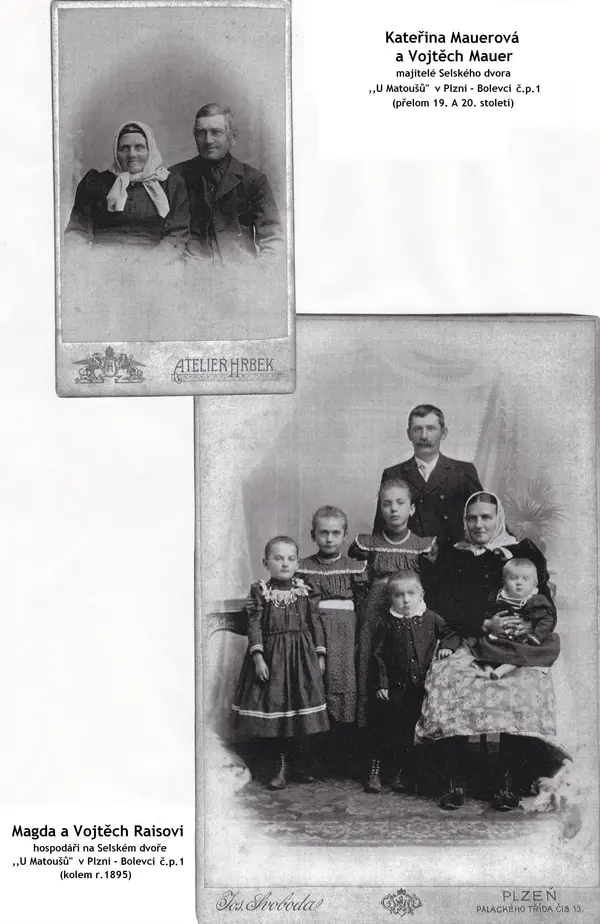
The Pechmann family then owned the farm until 1800, when Vojtěch Mauer, the reeve of Bolevec, bought it and embarked on the challenging reconstruction of the residential building, which was completed in 1809. His son František Mauer continued the construction work, focusing largely on farm and service buildings. The third generation of Mauers on the “U Matoušů” farmstead were the couple Vojtěch and Kateřina Mauer. Their eldest daughter Magdaléna married Vojtěch Rais, who lived at Bolevec No. 19, in 1888. The Rais family then took over the farm in 1891. The Rais family had five children; their only son died at a young age. During World War II, their youngest daughter Barbora Raisová also lived with them on the farm.
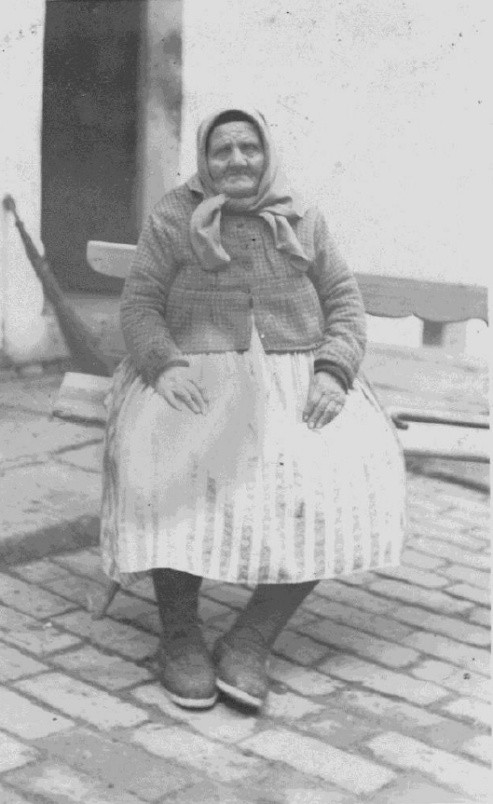
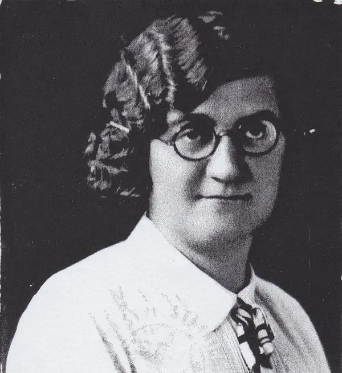
Barbora Raisová studied at the teacher training college in Hradec Králové and subsequently worked at a nursery school. She left for the United States in the 1920s, where she worked in Czech-English kindergartens in Nebraska and Iowa, where she became fluent in English.
During World War II, the farm housed a motorised Wehrmacht postal unit. Barbora Raisová secretly listened to foreign radio broadcasts, and on 4 May 1945 heard the news that American soldiers had crossed the Czechoslovak border and were headed towards Plzeň. The Germans were already preparing to leave in a hurry. Barbora Raisová convinced the local blacksmith Martin Pešek to help her hang the Czechoslovak flag on a linden tree in front of the building. The flag hung there for around three hours before German soldiers noticed it as they were leaving and shot it down. Thanks to this act of heroism, the flag in Bolevec was evidently the first Czechoslovak flag to be hung in the City of Plzeň before its liberation.
Marie Škrábková moved to the farm to live with her sister after the end of World War II. In 1952, the farm was taken over by the newly established Unified Agricultural Co-operative and Barbora Raisová, who was known as Bábinka, was accused of high treason. She was originally to be sentenced to death, but her sentence was later reduced to 18 years in prison. She was released after four years for medical reasons.
The two women were allowed to stay on the farm, but they were only allowed to use the residential building and had to care for the Unified Agricultural Co-operative’s poultry. No one took care of the farmstead, and in 1957 its owners were forced to sell their remaining lands to the Unified Agricultural Co-operative in order to repair the roof over their heads.
Marie Škrábková died in 1973 and her son PhDr. Karel Škrábek moved to the farm. He was an educated man, imprisoned for alleged espionage against the state, who was under constant surveillance by the State Security Service until 1989.
Barbora Raisová died in 1978. Karel Škrábek lived out his life as a recluse on the farm until his death in 2002.